
By Mark Schultz, land investor
I bought my first raw land parcel in Colorado after retiring from 25 years of active military service. I didn't buy it to flip it — I bought it because standing on that land felt like something worth holding onto. That parcel led to a second deal, then a third, and eventually to building a land investing operation from scratch while still on active duty, limited to roughly 1–2 hours a day.
That constraint shaped everything. I couldn't run a workflow that required me available during business hours. I couldn't afford inefficiency. Every system had to work without me watching it.
Most land investing guides cover the concept. They tell you what land flipping is, why the margins are good, how to get started. Then they stop — right before the part that determines whether your business actually works.
The operational layer lives in $500–$7,500 paid courses, scattered across 2,000+ podcast episodes, fragmented across forum threads that conflate land flipping with land development. Nobody has documented the complete process in one place. This is that document: eight stages from first mailer to closed deal, with specific tools, time benchmarks, and delegation frameworks at each step.
In 2023, my operation closed 13 property acquisitions and 12 sales — $47,802 in gross revenue, $23,293 in accrual profit, plus $42,110 in future receivables from seller-financed notes still collecting. Not projections. What the process produced in a single year, part-time, with documented systems and minimal overhead.
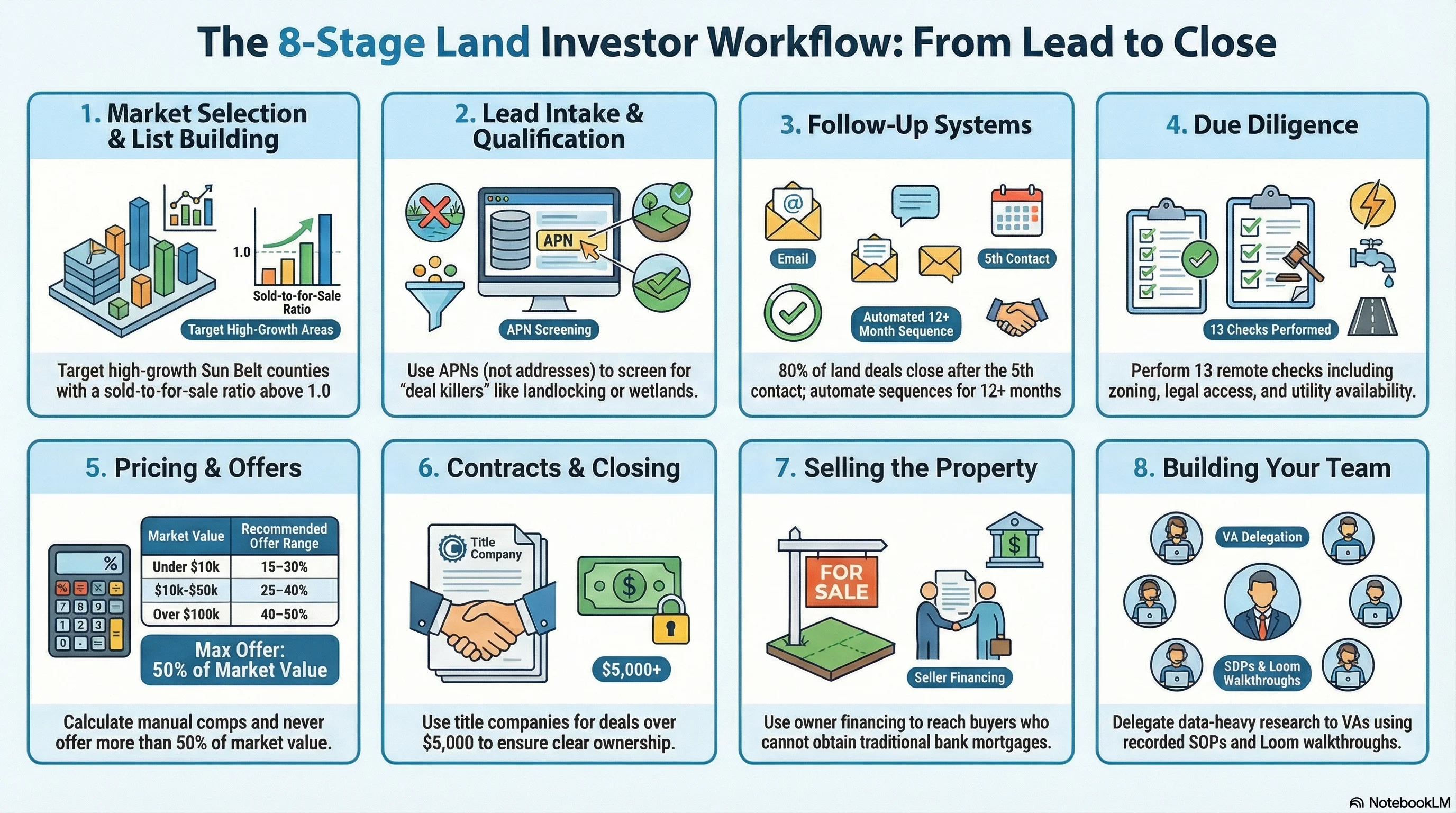
Why Generic Real Estate Guides Miss Land Investing Entirely
Raw land is not house flipping with fewer walls. The workflow is different at every stage:
- Properties are identified by APN (Assessor Parcel Number), not street address. Many vacant parcels have no address at all.
- Due diligence is county-level. Zoning, access, back taxes, deed status, utilities — verified through county offices and public databases, not an MLS sheet.
- Follow-up cycles run 6–12+ months. Sellers of vacant land may have owned a parcel for decades at near-zero carrying cost. They're not in a hurry.
- Seller financing is how most raw land gets sold. Banks don't mortgage vacant land. Owner financing is how you reach buyers who can't pay cash, which is most of them.
- VA delegation follows a specific order. The research-intensive work comes first. The judgment calls stay with you longest.
If you're reading a guide that doesn't address any of this, it was written for house flippers or wholesalers. Start over.
The 8-Stage Land Investor Workflow
Stage 1 — Market Selection and List Building
Where you operate matters more than how hard you work. Operators with a bad market grind for the same dollars as operators in a good one — they just work harder to get them.
Pick rural counties within 1–3 hours of major metros in Sun Belt states (Texas, Florida, North Carolina, Georgia, Tennessee, Arizona). Three filters determine whether a county is worth mailing:
Population growth. U.S. Census data. If people are moving toward it, buyers exist. If population is declining, you'll hold inventory.
Market liquidity. Seth Williams' sold/for-sale ratio: filter vacant lots on Zillow and Redfin, count how many sold in the last 12 months versus how many are listed right now. Ratio above 1.0 — things are selling. Below 1.0 — you'll be waiting.
County data accessibility. Online GIS, public assessor records, cooperative county offices. Some counties have everything online. Others require phone calls and physical trips. Avoid the ones that make due diligence hard — you'll be doing a lot of it.
List building filters: vacant land only, target acreage, absentee or out-of-state owners, long ownership duration, assessed value range, tax delinquent status. Scrub out landlocked parcels, HOA properties, flood zone properties, and duplicates before anything goes in the mail.
Data tools: DataTree (First American) is the most widely used for list generation and title data. PropStream has flat monthly pricing with transparent data freshness. Land Insights sources from First American at $0.10/exported record with AI-assisted scrubbing to remove unlendable properties.
Blind offers vs. neutral letters vs. ranged offers. This debate doesn't end. Land Academy teaches blind offers — specific dollar amounts, mailed without calling first. REtipster and most modern operators prefer neutral letters — express interest, let the seller call you, price the deal after you know they're motivated. The case against blind offers: you're pricing 95% of properties whose sellers will never respond. Ranged offers (something like "20–50% of assessed value") are an emerging middle ground. No head-to-head conversion data exists. Pick one, be consistent, track your results.
Stage 2 — Lead Intake and Qualification
When a seller calls or submits a form, you have one job: get the right information fast enough to know whether this deal is worth pursuing.
Fields that matter for vacant land (not the fields a house-flipping CRM will have by default):
- APN — the property's unique identifier. Many vacant parcels have no street address. The APN is how you find everything else.
- County and state
- Acreage
- Seller name, phone, email
- Asking price ("What would you need to get for this property?")
- Reason for selling and timeline
- Property access, utilities, back tax status
First call flow: Set the agenda. Use negative phrasing upfront to drop the seller's guard — "Sounds like I caught you in the middle of something?" works. Confirm property details. Ask about the deed. Check for back taxes. Ask about liens or HOA. Ask why they're selling. Ask about timeline and price. Don't pitch. Ask.
Things that kill a deal immediately: No legal road access (landlocked) — the number one deal killer in raw land, full stop. Wetlands. FEMA flood zone A/AE. Clouded title. HOA with unpaid dues (one investor found out after closing they owed $3,000+). Seller doesn't actually own the property. Environmental contamination. Terrain too steep for any reasonable use.
Roughly 10–20% of mailer responses are worth pursuing. The rest are curiosity, wrong contacts, or properties with immediate disqualifying issues. Don't be discouraged by the ratio — it's priced into the math.
Stage 3 — Follow-Up Systems
This is where most land businesses quietly fail. Not because leads dried up. Because the operator stopped following up too early.
Land sellers are not in a hurry. Someone who inherited 40 acres in 1985 may call you back out of curiosity, decide they're not ready, then sell you the property eight months later because you were still in their inbox. 80% of conversions happen after the 5th contact. Only 10% of investors make more than 3 attempts. If your follow-up stops at 3, you're handing the back half of your deal flow to whoever stays in contact longer.
Follow-up cadence that works:
- Day 0 — Respond within 5 minutes. Response within 5 minutes is 21x more effective than a 30-minute delay. Set this up so it happens automatically.
- Days 1–7 — Heavy multi-channel contact: phone, text, mail
- Week 2 — Follow-up if no response
- Weeks 3–4 — Different channel
- Months 2–3 — Bi-weekly automated drip
- Months 3–6 — Monthly check-in
- Months 6–12+ — Quarterly, indefinitely, until they opt out
Channel priority for land sellers: Calls first — older and rural landowners are less responsive to text and email. SMS for check-ins. Direct mail postcards for leads who don't answer the phone. Email last.
No land-specific follow-up conversion data exists anywhere. The cadences above are borrowed from house-flipping and adapted by land operators through trial and error. Anyone who publishes definitive "follow up X times on Y cadence" data for land is citing house flipping research or making it up.
Stage 4 — Due Diligence
Beginners spend 8+ hours on due diligence per property. Experienced operators do it in 1–3 hours, entirely remotely, without ever visiting the property for deals under $10,000–$15,000.
The difference isn't shortcuts. It's knowing exactly which 13 checks matter and doing them in the right order.
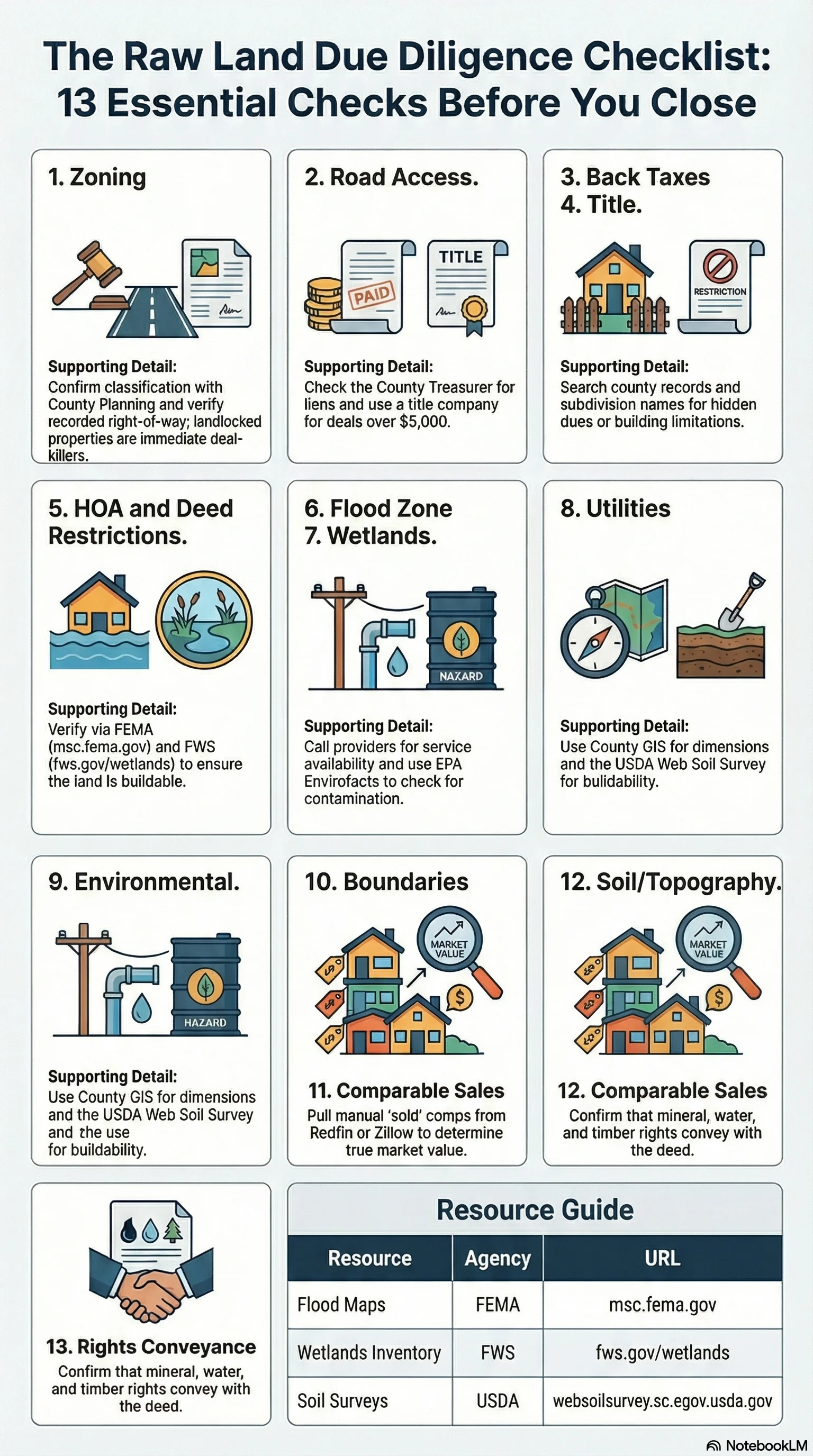
The non-negotiable due diligence checklist for raw land:
- Zoning and land use — Call county planning with the APN. Confirm classification. Never trust what the seller says can be built.
- Legal road access — Verify a recorded right-of-way. Landlocked = deal killer. Check this before everything else.
- Back taxes and liens — County treasurer website. Check special assessments and HOA dues separately.
- Title and chain of title — Verify the seller is the legal owner. For anything above ~$5,000, use a title company.
- HOA and deed restrictions — County records plus subdivision name search. HOA dues can eat your margin on a small deal.
- Flood zone — FEMA Flood Map Service Center (msc.fema.gov). Zone A or AE is high flood risk. Walk away.
- Wetlands — FWS National Wetlands Inventory (fws.gov/wetlands). Protected. Can't be filled or altered. Not buildable.
- Utilities — Call providers with the APN. Connected, available at road, or unavailable — it matters for pricing.
- Environmental — EPA Envirofacts plus Google Earth historical imagery.
- Property dimensions and boundaries — County GIS.
- Comparable sales — Redfin, Zillow, DataTree. No automated land valuations exist. You're pulling actual sold comps.
- Soil and topography — Google Earth, USDA Web Soil Survey, county GIS elevation.
- Mineral, water, and timber rights — Confirm whether they convey with the deed.
"The biggest mistake I see beginners make is spending too much time on due diligence before they know if the seller will accept their price. Do a quick pass first to identify any deal killers, then go deeper once you have a signed purchase agreement." — Seth Williams, REtipster
State variations matter. California requires natural hazard disclosures. Texas has water rights complexity. Florida has wetlands everywhere. North Carolina and South Carolina are implementing new wholesaling regulations in 2026. Build a state-specific addendum for each market you operate in — the 13-item list above is the national baseline.
Stage 5 — Pricing and Making Offers
Land comps are harder than house comps. There are no Zestimates. Price-per-acre breaks down when you're comparing a 1-acre infill lot to a 40-acre rural tract. About 13 states are non-disclosure — sale prices are hidden from public records. You're doing this manually every time.
Pricing methodology: Find 3–5 comparable vacant land sales within 10–15 miles. Calculate price per acre. Use the median, not the average — one outlier distorts an average badly. Adjust for access (±15–25%), utilities (±10–20%), water features (±25–50%), buildable zoning (±20–40%).
Offer percentage of market value (Seth Williams' published framework, one of the few in the niche):
| Market Value | Offer Range |
|---|---|
| Under $10,000 | 15–30% of market value |
| $10,000–$50,000 | 25–40% of market value |
| $50,000–$100,000 | 35–50% of market value |
| Over $100,000 | 40–50% of market value |
Never offer more than 50% of market value. That's the line.
Where to pull comps: Redfin is the operator's preferred tool — you can export sold data to CSV and sort by price per acre. Zillow has the audience but no land-specific filters. Lands of America and the Land.com Network are essential in non-disclosure states where Redfin and Zillow comp data disappears. PRYCD ($24.99/month or $499/year) aggregates comps from multiple sources but use it for reference, not gospel — Seth Williams calls their automated valuations "often wrong rather than right."
Stage 6 — Contracts and Closing
Three options. Pick based on deal size and state.
Self-closing — only for very low-value cash deals where title company fees would consume the profit. You prepare the deed, handle recording. Works in states with simple deed requirements and no attorney mandates. Limited use.
Title company closing — standard for anything above ~$5,000. They verify ownership, issue title insurance, handle escrow, record the deed. Timeline: 2–4 weeks. Cost: $350–$700. Common complaint: title companies wait until the last possible moment. Build that into your timeline expectations.
Attorney closing — required in some states (Georgia, South Carolina). Also required for your first seller-financed deal in any new state — hire a local foreclosure or creditor's rights attorney to draft your note and mortgage documents. Once you have attorney-approved templates for a state, subsequent deals use those templates.
Cash vs. seller financing: Seller financing (terms deal, owner financing) makes sense when the buyer can't get a traditional bank mortgage — which is most raw land buyers. You price at 100–110% of market value instead of 90–95%. You're paid over 3–10 years instead of at close. The tradeoff is real: you're now managing note payments.
Here's what the accounting looks like with an active seller-financing portfolio: In 2023, my books showed a cash basis net of ($18,817) — a paper loss — while accrual profit was $23,293. The gap wasn't losses. It was $42,110 in receivables sitting in seller-financed notes, not yet collected. New investors who see that cash statement and panic don't understand that the money is coming. It's just scheduled over years of monthly payments instead of one check at closing.
2026 note: New wholesaling regulations in North Carolina, South Carolina, Georgia, and Illinois affect assignment-based strategies. Double-closing requirements and disclosure mandates are expanding. Talk to a local real estate attorney before your first deal in a new state.
Stage 7 — Selling the Property
Platform priority:
- Land.com Network (Land.com, LandWatch, Lands of America, Land And Farm) — the primary destination for land buyers, 10 million+ monthly visitors. Start here.
- Facebook Marketplace and groups — free, strong for local buyers and owner-financed deals.
- Craigslist — old-school, still works for lower-priced rural properties. Repost constantly.
- Zillow — supplemental, not primary. Broad reach, poor land-buyer targeting.
- Owner-finance marketplaces — Landmodo, LandFlip for seller-financed deals.
Seller financing as a selling strategy: Banks don't make mortgages on raw land. Owner financing is how you reach the buyers who want your property but can't pay cash — which is most of them. You price 10–15% above what you'd get for a cash sale, you collect monthly payments, and your buyer pool triples.
What to include in a listing: Google Earth screenshots with boundaries marked, plat map, ground-level photos, drone footage for anything above $20,000, written description with APN, GPS coordinates, zoning, utilities, road access, nearby amenities. Physical signage with a QR code is worth the effort for rural properties with driving traffic.
Realistic time-to-sell: Aggressively priced land (10–15% below comps) moves in 30–90 days. Owner-financed deals can move faster because the buyer pool is larger. Land sitting at full market price on a single platform often takes 6–12 months — NAR data confirms this for vacant land nationally. Pete Stefaniak, who publishes deal-by-deal income reports, averaged 94.67 days in inventory across his September 2023 deals with 47,500 mailers sent that month and $305,872 in gross profit across 9 closed deals.
Stage 8 — Building Your Team
You can't scale past a handful of deals per month without delegation. The research work is too time-consuming and too repetitive to do personally at volume.
Hire from the Philippines via OnlineJobs.ph. Direct hire at $3–5/hour ($400–$800/month full-time). Skip agencies — they add cost without adding oversight or accountability.
What to delegate first, in order:
- List scrubbing and data entry (removing duplicates, landlocked parcels, flood zones)
- Initial due diligence research (APN pulls, county records, FEMA flood status)
- Mailer management (coordinating with mail houses, tracking campaigns)
- Lead intake logging (entering seller info from calls)
- Comp research (pulling Redfin and Zillow comparables)
- Listing creation (writing descriptions, uploading photos)
- CRM management and pipeline updates
- Follow-up scheduling
- Social media and content distribution
Before you hire, build the systems. You cannot delegate to a VA who has no instructions to follow. Every task needs a written SOP and a Loom video walkthrough. Best method: record yourself doing the task, narrate what you're doing and why, then have the VA convert the recording into a written SOP with screenshots. You end up with documentation you own, not tribal knowledge that walks out the door.
Tools your VA needs to operate: A CRM with a defined pipeline. Task management (Asana, Trello, or ClickUp). Communication in Slack, not WhatsApp — searchable, organized by channel, usable across time zones. Password management through LastPass or 1Password.
When to hire: When research and data entry is consuming more than 10 hours of your personal time per week. Or when you're dropping leads because you can't keep up with intake. Either signal means the bottleneck is you, not the market.
What Does a Land Investor's Daily Workflow Actually Look Like?
At low volume (1–5 deals per month), your day is lead intake, due diligence, and follow-up. Mailers go out monthly. Responses trickle in over 2–4 weeks. Follow-ups run in parallel from every previous campaign.
At higher volume (20+ deals per month), you stop doing tasks and start managing them. Pipeline review, negotiation calls, market planning, VA oversight — that's the job. You're managing output, not executing every step.
Part-time is where most people actually start — and where no guide addresses. I built my land operation while on active duty, limited to 1–2 hours per day in short sessions. The key adjustment: everything had to be asynchronous. Seller calls couldn't happen during business hours when I wasn't available. Follow-up had to run automatically. Due diligence had to be batchable by a VA. Deal flow was slower, but the process was identical — just on a longer timeline and dependent entirely on systems rather than personal presence.
A day at 1–5 deals/month (part-time):
- Morning (20–30 min): Review new leads, check follow-up queue, review VA output
- Evening (30–60 min): Due diligence calls, seller negotiations, campaign planning
A day at 5–10 deals/month (solo or one VA):
- Morning: New leads from overnight calls and form submissions
- Mid-morning: Due diligence on qualified leads from previous day
- Afternoon: Follow-up calls, pipeline updates
- End of day: VA review, next day prep
A day at 20+ deals/month (VA team):
- Morning: Pipeline review — what moved, what's stuck
- Mid-morning: Seller calls requiring negotiation or offer adjustment
- Afternoon: Market selection and campaign planning
- End of day: Deal economics on anything under contract
Offer Strategy Comparison: Blind Offers vs. Neutral Letters vs. Ranged Offers
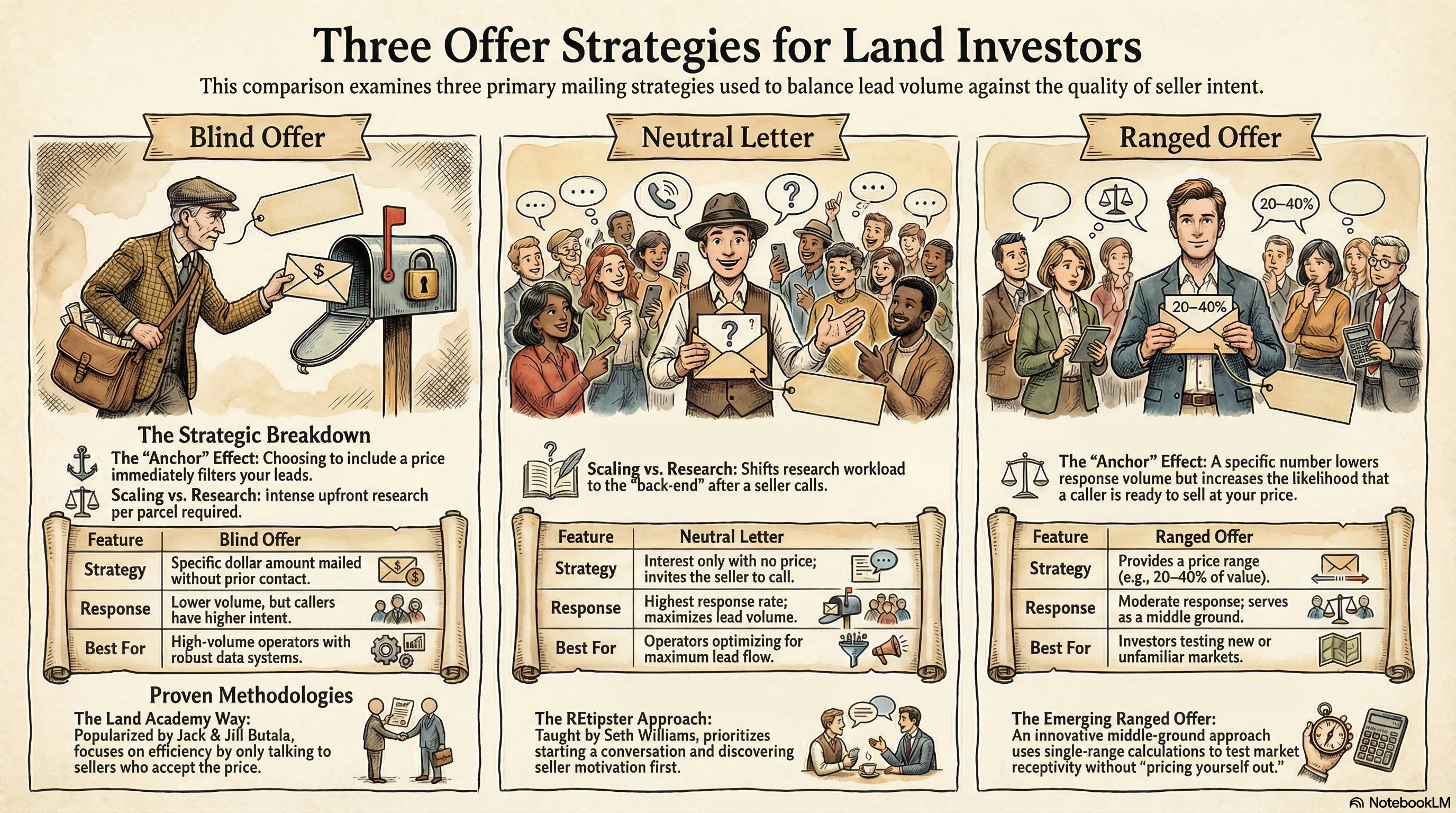
| Blind Offer | Neutral Letter | Ranged Offer | |
|---|---|---|---|
| What you send | Specific dollar offer, no prior contact | Interest letter, no price, invite them to call | Price range (e.g., 20–40% of assessed value) |
| Research before mailing | Full comps per parcel | List filter only | Single range calculation |
| Response rate | Lower — low number may get ignored | Higher — no anchor price to reject | Moderate |
| Seller intent on response | Higher — they called knowing your number | Mixed — curiosity and motivated sellers | Mixed |
| Who teaches it | Land Academy (Jack & Jill Butala) | REtipster, most modern operators | Emerging, no major course behind it yet |
| Best fit | High-volume operators with data systems to price at scale | Operators optimizing for response volume | Testing new markets |
No published conversion data compares these on identical campaigns. Pick one based on your operation's bandwidth for pre-mailer research. Track your own results.
How Long Does Each Stage Take?
| Stage | Beginner | Experienced |
|---|---|---|
| Market selection | 1–2 weeks | 1–2 hours |
| List building | 4–8 hours per campaign | 1–2 hours with VA |
| Lead intake per call | 20–30 min | 10–15 min |
| Due diligence per property | 8+ hours | 1–3 hours |
| Pricing and offer | 2–4 hours | 30–60 min |
| Contracting | 1–3 hours | 30 min with templates |
| Closing (title company) | 2–4 weeks | 2–4 weeks |
| Time to sell | 3–6+ months | 30–90 days (aggressively priced) |
What You Need Before You Can Scale
Plateauing at 3–5 deals per month is almost never a market problem. It's a systems problem. The operators stuck there know how to do land investing. They don't have the infrastructure to hand work off without it breaking.
Minimum stack before delegation is possible:
- CRM with named pipeline stages — New Lead → Contacted → Qualified → Offer Made → Under Contract → Due Diligence → Closing → Closed. Without this, nothing is delegable. "Check on all the leads" is not a VA task.
- Follow-up automation — not optional. The 80% of conversions that happen after the 5th touch require a sequence that runs whether you're watching it or not.
- Mailer system — mail house relationship, campaign calendar, list-building process a VA can execute without you.
- SOPs for every repeatable task — written doc plus Loom recording. Every checklist. Every research step.
- Deal economics tracking — cost per deal, days in inventory, margin per deal. Pete Stefaniak tracks average days in inventory as a primary KPI. His target: under 90 days. His September 2023 average: 94.67 days, across 9 deals, $33,986 average profit per deal.
- Communication infrastructure — Slack, business phone with call recording, task management for VA work.
Frequently Asked Questions
What is the land investor workflow from lead to close?
Eight stages: market selection and list building, lead intake and qualification, follow-up, due diligence, pricing and offers, contracts and closing, disposition, and VA delegation. From first mailer to closed deal takes 3–6 months for a beginner working at normal pace and 30–90 days for an experienced operator pricing aggressively.
What does a land investor's daily workflow look like?
At low volume, you're doing intake, DD, and follow-up yourself. At scale, you're managing pipeline and people — reviewing what moved, handling negotiation calls, planning the next campaign. The work you're doing shifts from operator to manager as volume grows. If you're at 20+ deals per month and still doing your own DD research, your bottleneck is you.
What systems do land investors use to scale their business?
A CRM with defined pipeline stages, automated follow-up sequences, a repeatable mailer process, written SOPs for every VA task, and deal economics tracking. Those five things. Missing any one of them, delegation breaks down and volume growth just creates more chaos.
How do you do due diligence on raw land?
Thirteen checks: zoning (county planning), road access (county records or GIS), back taxes (county treasurer), title (title company for deals over $5,000), HOA/deed restrictions, flood zone (FEMA msc.fema.gov), wetlands (FWS fws.gov/wetlands), utilities (provider calls), environmental (EPA Envirofacts), boundaries (county GIS), comps (Redfin, Zillow, Land.com), soil and topography (USDA Web Soil Survey), and rights conveyance. Experienced operators complete all 13 remotely in 1–3 hours.
What is the county research process for land investing?
Start with the APN. Run it through: county assessor (ownership, assessment), county treasurer (back taxes), county GIS (boundaries, road access), county planning (zoning), FEMA flood maps. Most of this is online. Call the planning department to confirm zoning — never take the seller's word for what can be built. That call takes 5 minutes and has saved deals.
How do land investors price their offers?
Pull 3–5 comparable vacant land sales within 10–15 miles. Median price per acre, adjusted for access, utilities, and zoning. Offer 15–50% of derived market value depending on the deal size — lower percentages for smaller properties, higher for larger. Seth Williams' published framework: 15–30% for sub-$10K properties, 35–50% for above $50K. Never go above 50%.
How do you run a land investing business with a VA?
Delegate list scrubbing and DD research first — the most time-consuming, most repeatable tasks. Hire direct from the Philippines via OnlineJobs.ph ($3–5/hour). Before they start, every task needs a Loom recording and written SOP. The VA handles structured research. You handle seller calls and final judgment calls until you have deep enough bench to trust them with more.
What is a realistic follow-up strategy for land investing leads?
Respond within 5 minutes. Heavy multi-channel contact in the first week. Bi-weekly automated drip through months 2–3. Monthly check-ins through month 6. Quarterly touches after that, indefinitely. Land sellers aren't in a rush — they may have owned a parcel for 30 years. The operators who follow up for 12+ months close deals that competitors stopped chasing at attempt 3.